Power Semiconductor Devices

More on this category »

Latest Post

Showing posts with label Triac. Show all posts

Device Protection with Thyristors

di/dt Protection
A minimum time is required for the thyristor to spread the current conduction uniformly throughout the junctions. If this time is not allotted and the rate of rise of anode current is very high compared to the spreading velocity at turn-on, then this could lead to localized "hot-spot" heating and the device may fail as a result of excessive heating.

For an inductive load, when thyristor T1 is turned off, free-wheeling diode Dm conducts load current. If thyristor T1 is fired when diode Dm is still conducting, di/dt can be very high. In order to reduce the high di/dt a series inductor Ls is added to the circuit as shown. The forward di/dt is given as
\frac{{di}}{{dt}} = \frac{{{V_S}}}{{{L_S}}}
Device Protection with Thyristor
 Thyristor di/dt Protectiondv/dt Equivalent
\frac{{dv}}{{dt}} = \frac{{0.632{V_S}}}{\tau } = \frac{{0.632{V_S}}}{{{R_S}{C_S}}}
{R_S} = \frac{{{V_S}}}{{{I_{TD}}}}
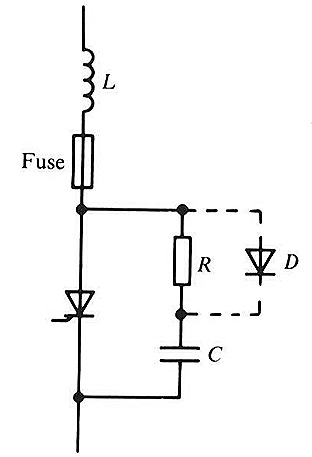
As seen earlier, a high dv/dt may cause damage to a thyristor. In order to protect a thyristor from high dv/dt, the circuits shown in figure above could be used.
The value of the snubber time constant RSCS can be found for a known dv/dt. And for a known discharge current ITD , the value of resistor RS can be found using the above equation.dv/dt Equivalent of Thyristor
Exercise-1
The dv/dt rating of the thyristor in the circuit shown in Figure below is 100V/μs. Determine the minimum value of C so that no accidental turn on of the thyristor occurs due to the dv/dt rise when S is close.
previous TRIAC
next Thyristor Gate Control or Firing Circuit Design

TRIAC

The bi-directional thyristor or TRIAC conducts current in both directions. It can be considered as two SCRs connected in antiparallel with a common gate connection.
The TRIAC structure, symbol and VI characteristics are shown in figure. In I+ mode, the terminal MT2 is positive and the device is switched on by a positive gate current pulse. In III– mode, the terminal MT1 is positive and the device is turned on by a negative gate pulse.
For ac power control, a triac is more economical than an inverse-parallel thyristor combination, but it has a few drawbacks.
  1. The gate current sensitivity is somewhat lower and turn-off time is slower than for a thyristor.
  2. Besides, the reapplied dv/dt capability is poor and, therefore, it is difficult to operate with an inductive load.
bi-directional thyristor or TRIAC conducts current in both directions
Triacs are commonly used in incandescent lamp dimming and heating control, where the load is resistive. Figure shows the popular triac light dimmer circuit. The gate of the triac is supplied from an R-C circuit through a diac.
A diac shown in the figure is a symmetric voltage-blocking device.Triac-symmetric voltage-blocking device
The variable resistance R1 controls the dimming level of the lamp, which is connected in series. When the capacitor voltage VC in either polarity exceeds the threshold voltage ±VS of the diac, a pulse of current triggers the triac at a firing angle (α), giving phase-controlled, full-wave current to the lamp.
When the triac is on, the R-C circuit is shorted and the line voltage is impressed across the lamp. At the end of every half-cycle, the triac turns off and the next half-cycle begins. An R-C snubber as shown is important to a triac circuit to reduce reapplied dv/dt.
previous Gate Turn-On Characteristics of Thyristors
next Device Protection with Thyristors