Power Semiconductor Devices

More on this category »

Latest Post

Showing posts with label Power Electronic Converter. Show all posts

Classification of Converters

Classification of Converters (Based on Commutation)
Based on how the power semiconductor devices within the converter are switched, 3 major classes:
  1. Line frequency (naturally commutated) converters
  2. Switching ( including forced commutated) converters
  3. Resonant and quasi-resonant converters
Line frequency converters: the devices are turned off by the utility line voltage at one side of the converter and turned on, phase locked to the line voltage waveform by a triggering circuit. For ac-dc, ac-ac (frequency = input frequency, rms ≤ input rms).
Switching converters: the controllable switches in the converter are turned on and off at frequencies that are high compared to the line frequency. For dc-dc, dc-ac, ac-ac (variable frequency and rms, where the frequency ≤ the input frequency).
Resonant converters: the controllable switches turn on and/or turn off at zero voltage and/or zero current. For dc-dc, dc-ac.
Classification of Converters (Based on Functions)
Converters Input to Output Conversion
1. AC VOLTAGE CONTROLLER
Fixed to Variable ac (Line Commutation).
2. RECTIFIERS (Uncontrolled).
Fixed ac to Fixed dc (Line Commutation).
3. RECTIFIERS (Controlled).
Fixed ac to Variable dc (Line Commutation).
4. DC-to-DC (Chopper).
Fixed dc to Variable dc (Load or Forced Commutation).
5. INVERTERS (Uncontrolled).
Fixed voltage dc to Fixed ac (Line, Load, Forced).
6. INVERTERS (Controlled).
Fixed voltage dc to Variable ac (Line, Load, Forced).
7. CYCLO CONVERTERS.
Fixed ac voltage ac to Variable ac voltage & Frequency (Line or Forced).
Ac-ac Converter
A. Output frequency is equal to input frequency (output rms voltage can be varied)
TRIAC based Ac Voltage regulator (low voltage and current rating)
Thyristor based AC voltage regulator (high voltage and current rating)
B. Output frequency is less than input frequency (output rms voltage can be varied)
Cycloconverter
{V_{o(rms)}} = \frac{{{V_m}}}{{\sqrt 2 }}{\left[ {\frac{1}{\pi }\left( {\pi  - \alpha  + \frac{{\sin 2\alpha }}{2}} \right)} \right]^{\frac{1}{2}}}

TRIAC BASED Ac-ac Converter and waveforms
Fig. TRIAC BASED Ac-ac Converter and waveforms.
Ac-dc Converter (Rectifier) Two Types
  1. Diode Rectifier (uncontrolled rectifier)
  2. Ac-dc converters (controlled rectifiers)
Diode Rectifiers
{V_{o(average)}} = \frac{{2{V_m}}}{\pi } 
Diode Rectifiers Ac-dc Converter (Controller Rectifier)

{V_{o(average)}} = \frac{{2{V_m}}}{\pi }\left( {1 + \cos \alpha } \right)
 
Ac-dc Converter (Controller Rectifier) Dc-dc Converter (Chopper)
Three Types:
  1. Buck (step-down)
  2. Boost (step-up)
  3. Buck-boost
{V_{o(average)}} = \delta {V_S}
 
buck converter or chopper Fig. buck converter or chopper
Dc-ac Converter (Inverter)
Output AC may be Single-phase or three-phase.
{V_{o(rms - fundamental)}} = \frac{{4{V_S}}}{{\pi \sqrt 2 }} = 0.90{V_S}
 
single-phase inverter Fig. single-phase inverter
previous Applications of Power Electronics
next Design Consideration of Power Electronic Equipment

Thyristor Three-Phase, Six-Pulse Converter (PROCEDURE)

Setting up the equipment
(1) Install the Power Supply, the Enclosure / Power Supply, the DC Motor Generator, the Four-pole Squirrel-Cage induction Motor, the Smoothing inductors, the DC Voltmeter/Ammeter, the Three-Phase Wattmeter/Varmeter, the Tandem Rheostats and the Power-Thyristors modules in the Mobile Workstation.
Note: Align the brushes of the DC Motor / Generator in the neutral position by centring the metal tab on the red mark (on the casing).
(2) Install the Thyristor Firing Unit and the Current/Voltage isolators in the Enclosure / Power Supply.
Note: Before installing the Thyristor Firing Unit, make sure that switches SW1 and SW2 (located on the printed circuit board) are in the 0 position.
(3) Make sure that the main power switch of the Power Supply is set to the 0 (OFF) position. Connect the Power Supply to a three-phase wall receptacle.
(4) Plug the Enclosure / Power Supply line cord into a wall receptacle. Set the rocker switch of the Enclosure / Power Supply to the 1 (ON) position.
(5) On the Power Supply, set the 24-V ac power switch to 1 (ON) position.
Rectifier and inverter modes
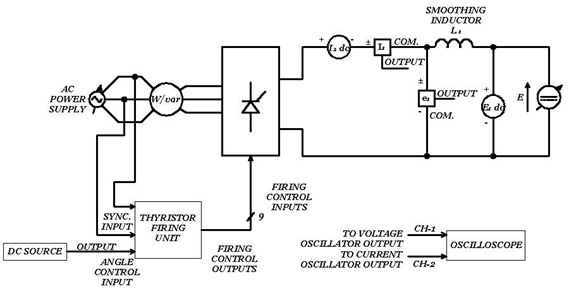
(6) Set up the circuit of Figure 4.
Three-phase, six-pulse converter circuit
Figure 4: Three-phase, six-pulse converter circuit.
LINE
VOLTAGE
(Vac)
I1 dc
(A)
I1
(A)
e1
(V)
E1 dc
(V)
L1
(H)
120 2.5 10 300 150 0.2 (3 A dc max.)
220 1.5 5 600 300 0.8 (1.5 A dc max.)
240 1.5 5 600 300 0.8 (1.5 A dc max.)
(7) Make the following settings:
On the Power Supply
Voltage Selector  . . . . . . . . . . . . . . . . . . . . . . . . . . . 4-5
On the Thyristor Firing Unit
ANGLE CONTROL COMPLEMENT . . . . . . . . . . . . . . . . .  0
ANGLE CONTROL ARC COSINE . . . . . . . . . . . . . . . . . . . 0
FIRING CONTROL MODE . . . . . . . . . . . . . . . . . . . . . .  3~
DC SOURCE . . . . . . . . . . . . . . . . . . . . . . . . . . . . . MAX.
On the Oscilloscope
Channel-1 Sensitivity . . . . . . . . . . . . . . . . . . . . . . . . . 5 V/DIV. (DC coupled)
Channel-2 Sensitivity . . . . . . . . . . . . . . . . . . . . . . . . . 1 V/DIV. (DC coupled)
Time Base . . . . . . . . . . . . . . . . . . . . . . . . . . . . . . . . . . . . . . . . .  2 ms/DIV.
Trigger . . . . . . . . . . . . . . . . . . . . . . . . . . . . . . . . . . . . . . . . . . . . . . .  LINE
(8) On the Tandem Rheostats, set the control knob to the centre position. On the power Supply, make sure that the voltage control knob is set to the 0 position, then set the main power switch to 1 (ON). The Four-Pole Squirrel-Cage Induction Motor should begin to rotate.
On the Power Supply, adjust the voltage control knob to obtain the line-to-line voltage shown in table 1, as indicated by the voltmeter on the Power Supply.
LINE
VOLTAGE
LINE-TO-LINE
VOLTAGE
Vac
Vac
120 90
220 175
240 175
Table 1: Line-to-line voltage.
Turn the control knob on the Tandem Rheostats to adjust the voltage E of the dc source to the level indicated in Table 2.
LINE
VOLTAGE
DC SOURCE 
VOLTAGE
E1dc
Vac
V
120
100
220
200
240
200

Table 2: DC source voltage E1.
Vary the firing angle and observe the effect on the waveforms and on the current delivered to the active load. How does the current vary as the firing angle is reduced to 0°? . . . . . . . . . . . . . . . . . . . . . . . . .
(9) On the Thyristor Firing Unit, adjust the FIRING ANGLE to 0°, adjust the Tandem Rheostats to obtain the current I1 shown in Table 3.
LINE
VOLTAGE
CURRENT
I1dc
Vac
A
120
0.5
220
0.25
240
0.25

Table 3: Current I1 delivered to load.
For each FIRING ANGLE in Table 4 adjust the Thyristor Firing Unit to the given firing angle, then adjust the Tandem Rheostats to obtain the current I1 Shown in Table 3. Observe the waveforms on the oscilloscope. Calculate the theoretical output voltage, record the measured voltage E1dc as well as reactive power, and calculate the active power delivered to the reversible dc power supply.
Note: Do not increase the firing angle beyond 165° or the current will increase suddenly. If this happens reduce the firing angle to approximately 120° to restore normal operation.
FIRING
ANGLE
THEORETICAL VOLTAGE
E0 = 1.35 Es cos
MEASURED
VOLTAGE
E1dc
ACTIVE
POWER
P = E1 × I1
REACTIVE
POWER
Q
degree
V
V
W
var
0
15
30
45
60
75
90
105
120
135
150
165
Table 4: Data for three-phase, six-pulse converter.
(10) Turn the knob on the Tandem Rheostats to the centre position, so the field current in the DC Motor / Generator is zero. On the Power Supply, set the voltage control knob to 0 then set the main power switch and the 24-V ac power switch to 0 (OFF).
For what range of firing angle does the converter operate as a rectifier? For what range does it operate as a inverter? Explain.  . . . . . . . . . . . . . . . . . . . . .
In Figure 5, plot the output voltage E1 versus the firing angle. Then, in the same figure, plot the theoretical relationship E0 = 1.35 Es cos , where Es is the line voltage. Compare the two curves.Thyristor Three-Phase, Six-Pulse Converter
Figure: 5
Describe how the active and reactive power change as the firing angle is varied.  . . . . . . . . . . . . . . .
(11) Set the rocker switch on the Enclosure / Power Supply to the 0 position. Remove all leads and cables.
CONCLUSION
In the exercise, you observed that a three-phase, six-pulse converter can operate both as a rectifier and as an inverter. You demonstrated that the static transfer function obtained experimentally is similar to the theoretical curve.
REVIEW QUESTIONS
  1. What are the advantages of the three-phase, six pulse converter over other rectifier/inverter circuits? . . . . . . . . . . . . . . . . . . .
  2. Why is it advantageous to have a high ripple frequency at the output of a rectifier? . . . . . . . . . . . . . . . . . . . . . . . . . . . . .
  3. What is the average output voltage E0 for a three-phase, six pulse converter if the line-to-line source voltage is 240 V and the firing angle is 75°? . . . . . . . . . . . . . . . . . . . . . . . . . . . .
  4. What is the average current in each of the three ac line in a three-phase, six-pulse converter? . . . . . . . . . . . . . . . . . . . . .
  5. What are the advantages and disadvantages of a three-phase bridge made with three thyristors and three diodes? . . . . . . . . .
previous Thyristor Three-Phase, Six-Pulse Converter

Thyristor Three-Phase, Six-Pulse Converter


OBJECTIVE
  1. To study the operation of the three-phase, six-pulse rectifier/inverter.
  2. To plot the static transfer function of the three-phase, six-pulse rectifier/inverter, and compare this with the theoretical curve.
    DISCUSSION

    The three-phase, six-pulse thyristor converter, or rectifier inverter, shown in Figure 1, is used in power electronics. This type of circuit gives the highest and most regular output voltage with the least amount of ripple. It can function as a rectifier or, when connected to a correctly polarized dc source, as an inverter.
    This is the static transfer function of a three-phase, six-pulse converter, and is valid only when the on-time of the thyristors is equal to 120°. That is, when the series inductor is large enough to ensure continuous conduction.

    Three-phase, six-pulse converter with resistive load Figure 1: Three-phase, six-pulse converter with resistive load.
    Waveforms for the three-phase, six-pulse converter Figure 2: Waveforms for the three-phase, six-pulse converter.
    With respect to the three-phase restifier/inverter, the six-pulse circuit has the following differences:
    1. the average value of ED is twice as great
    2. the transfer of active power is two times greater with the same value of current
    3. the ripple frequency of E0 is 360 Hz instead of 180 Hz
    4. the average value of current IA , IB , IC is zero.
    This last difference is important because it prevents saturation of the transformers supplying the converter. According to Kirchhoff’s current law, IA = I1 - I4. We can therefore draw the curve of IA as shown in Figure 2. IA changes polarity each half cycle. being equal to I1 than -I4 , and then repeating again. IA flows for 240° or two-third of the cycle.
    Three-phase bridge using three thyristors and three diodes
    A three-phase bridge can be made using three thyristors and three diodes. Figure 3 shows an example of such circuit.
    Three-phase bridge using three common-cathode thyristors Figure 3: Three-phase bridge using three common-cathode thyristors.
    The free-wheeling diode D4 is necessary to ensure that the circuit be able to turn off an inductive load. Without this diode, when the gate pulses are stopped, the current may never drop to zero and one thyristor may continue to conduct.The freewheeling diode also relives the thyristors from freewheeling duty, allowing the use of lower power thyristors.
    One advantage of the circuit in Figure 3 is that the firing control circuit can be simplified since the cathode of the three thyristors are at a common potential. This circuit is of lower cost than a three-phase six-thyristor bridge of comparable power, and both allow control of power from 0 to 100%. Unlike the six-thyristor bridge, however, this bridge cannot be used to make a line-commutated inverter.
    Procedure summary
    In the first part of this exercise, you will set up the equipment.
    In the second part of this exercise, you will operate the three-phase, six pulse converter in both the rectifier and the inverter modes. You will plot the static transfer function of the converter, and compare it to the theoretical curve.
    next Thyristor Three-Phase, Six-Pulse Converter (PROCEDURE)

    Thyristor Single-Phase Bridge Rectifier/Inverter (PROCEDURE)

    Setting up the equipment
    (1) Install the Power Supply, the Enclosure / Power Supply, the DC Motor / Generator, the Four-Pole Squirrel-Cage Induction Motor, the Resistive Load, the Smoothing inductors, the DC Voltmeter/Ammeter, the AC Ammeter, the Three-Phase Wattmeter/Varmeter, the Temdem Rheostates, the Power Thyristors, and the Power Diodes modules in the Mobile Workstation.
    Note: Align the brushes of the DC Motor / Generator in the neutral position by centering the metal tab on the red mark (on casing).
    (2) Install the Thyristor Firing Unit and and the Current/Voltage Isolators in the Enclosure / Power Supply.
    Note: Before installing the Thyristor Firing Unit, make sure that switches SW1 and SW2 (located on the printed circuit board) are in the 0 position.
    (3) Make sure that the main power switch of the Power Supply is set to the 0 (OFF) position. Set the voltage control knob to 0. Connect the Power Supply to a three-phase wall receptacle.
    (4) Plug the Enclosure / Power Supply line cord into a wall receptacle. Set the rocker switch of the Enclosure / Power Supply to the 1 (ON) position.
    (5) On the Power Supply, set the 24-V ac power switch to the 1 (ON) position.
    (6) Make sure that the toggle switches on the Power Thyristors and the Resistive Load modules are all set to the 0 (open) position.
    Controlled bridge supplying a passive load
    (7) Set up the circuit of Figure 12 using the resistive load Z (a). To simplify connecting the thyristors, set both interconnection switches on the Power Thyristors module to the 1 position.
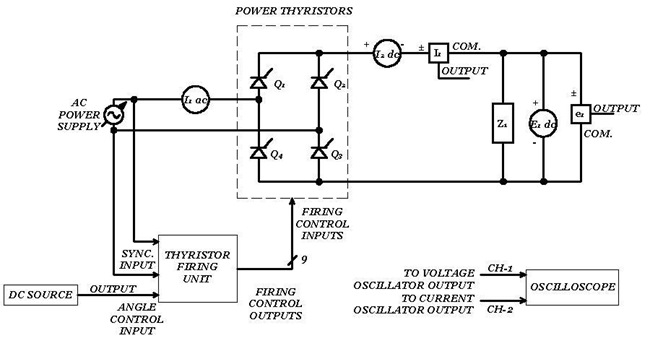
    Rectifier: Controlled bridge supplying a passive load Figure 12: Thyristor bridge circuit.
    LINE VOLTAGE (Vac)
    I1ac
    (A)
    I2dc
    (A)
    I1
    (A)
    E1dc
    (V)
    e1
    (V)
    Z1(a)
    EEEbold109
    Z1(a)
    EEEbold110
    120
    2.5
    2.5
    10
    150
    300
    R=60Ω
    R=60Ω, L=0.2H (3Adc max)
    220
    1.5
    1.5
    5
    300
    600
    R=220Ω
    R=220Ω, L=0.8H (1.5Adc max)
    240
    1.5
    1.5
    5
    300
    600
    R=240Ω
    R=240Ω, L=0.8H (1.5Adc max)
    (8) Make the following setting:
    On the Power Supply
        Voltage Selector . . . . . . . . . . . . . . . . . . . . . . . 4-N
    On the Thyristor Firing Unit
        ANGLE CONTROL COMPLEMENT . . . . . . . . . . . . . . .  0
        ANGLE CONTROL ARC COSINE . . . . . . . . . . . . . . . .  0
        FIRING CONTROL MODE . . . . . . . . . . . . . . . . . . . . 1~
        DC SOURCE . . . . . . . . . . . . . . . . . . . . . . . . . . . MIN.
    On the Oscilloscope
        Channel-1 Sensitivity . . . . . . . .  5 V/DIV. (DC coupled)
        Channel-2 Sensitivity . . . . . . . .  2 V/DIV. (DC coupled)
        Time Base . . . . . . .  . . . . . . . . . . . . . . . .  5 ms/DIV.
        Trigger . . . . . . . . . . . . . . . . . . . . . . . . . . . . .  LINE
    Rectifier: Voltage and current waveforms (α = 45°) Figure 13: Voltage and current waveforms (α = 45°).
    (9) On the power Supply, make sure that the voltage control knob is set to the 0 position then set the main power switch to 1 (ON). Set the voltage control knob so that voltage indicated by the Power Supply voltmeter is equal to 90 % of the nominal line-to-neutral voltage.
    On the Thyristor Firing Unit, set the FIRING ANGLE to 45°. Sketch the voltage and current waveforms in Figure 13.
    Fill in the first row of Table 1.
    LOAD
    Z1
    OUTPUT
    VOLTAGE
    E1 dc
    OUTPUT
    CURRENT
    I1 dc
    OUTPUT
    POWER
    P0 = E1 × I1
    CONDUCTION
    ANGLE
    V A W degrees
    (a) Resistive
    (b) Inductive
    Table 1: Measurements for controlled bridge (α = 45°).
    On the Power Supply, set the voltage control knob to 0 then set the main power switch to 0 (OFF).
    (10) Change the load in the circuit to the inductive load Z1 (b).
    On the Power Supply, set the main power switch to 1 (ON). Set the voltage control knob so that the voltage indicated by the Power Supply voltmeter is equal to 90 % of the nominal line-to-neutral voltage. Sketch the voltage and current waveforms in figure 13.
    Fill in the second row of Table 1.
    On the Power Supply, set the voltage control knob to 0 then set the main power switch to 0 (OFF).
    (11) Add a free-wheeling diode to the circuit, as shown in Figure 14. On the Power Supply, set the main power switch to 1 (ON), and set the voltage control knob to 90(%)
    Thyristor bridge with free-wheeling diode Figure 14: Thyristor bridge with free-wheeling diode.
    LOAD
    Z1
    OUTPUT
    VOLTAGE
    E1 dc
    OUTPUT
    CURRENT
    I1 dc
    OUTPUT
    POWER
    P0 = E1 × I1
    V A W
    (b) Inductive
    Table 2: Measurements for controlled bridge with free-wheeling diode.
    Single-phase bridge with two thyristors and two diodes 
    (12) Set up the circuit of Figure 15.
    Bridge rectifier wit two thyristors on common ac line Figure 15: Bridge rectifier wit two thyristors on common ac line.
    LINE VOLTAGE (Vac)
    I1ac
    (A)
    I2dc
    (A)
    I1
    (A)
    E1dc
    (V)
    e1
    (V)
    Z1(a)
    EEEbold110
    120
    2.5
    2.5
    10
    150
    300
    R=60Ω, L=0.2H (3Adc max)
    220
    1.5
    1.5
    5
    300
    600
    R=220Ω, L=0.8H (1.5Adc max)
    240
    1.5
    1.5
    5
    300
    600
    R=240Ω, L=0.8H (1.5Adc max)
    On the Power Supply; set the main power switch to 1 (ON), and set the voltage control knob so that the voltage indicated by the Power Supply voltmeter is equal to 90 % of the nominal line-to-neutral voltage. Vary the firing angle and observe the waveforms. Then set the firing angle to 45° and fill in the first row of Table 3.
    CONFIGURATION
    OUTPUT
    VOLTAGE
    E1 dc
    OUTPUT
    CURRENT
    I1 dc
    OUTPUT
    POWER
    P0 = E1 × I1
    V
    A
    W
    Two thyristors on common ac line
    Common-cathode thyristors
    Table 3: Measurements for bridge rectifiers with two thyristors and two diodes (α = 45°).
    Compare the voltage waveform at the output of this bridge to those obtained with the thyristor bridges of Figure 12 and 14.
    On the Power Supply, set the voltage control knob to 0 then set the main power switch to 0 (OFF).
    (13) Set up the circuit of Figure 16.
    Bridge rectifier with common-cathode thyristors and free-wheeling diode Figure 16: Bridge rectifier with common-cathode thyristors and free-wheeling diode.
    On the Power Supply, set the main power switch to 1 (ON), and set voltage control knob so that the voltage indicated by the Power Supply voltmeter is equal to 90 % of the nominal line-to-neutral voltage. Vary firing angle and observe the waveforms. Then set the firing angle to 45° and fill in the second row to Table 3.
    Compare the voltage waveform at the output of this bridge to those obtained with the bridge of Figure 15.
    (14) On the Power Thyristors, connect the FIRING CONTROL INPUTS DISABLE jack to + 5 V jack on the Enclosure / Power Supply. This disables the gate pulses to all of the thyristors, and shuts off current to the load. What happens? . . . . . .
    (15) On the Power Thyristors, disconnect the FIRING CONTROL INPUTS DISABLE jack from the + 5 V jack on the ENCLOSURE / Power Supply.
    On the Power Supply, set the voltage control knob to 0 then set the main power switch to 0 (OFF).
    Remove the free-wheeling diode from the circuit. Then, on the Power Supply, set the main power switch to 1 (ON), and  set the voltage control knob to 90(%).
    Could this bridge operate without the free-whiling diode? Explain. . . . . . . . . . . . .
    ON the Power Thyristors, connect the FIRING CONTROL INPUTS DISABLE jack to + 5 V jack on the Enclosure / Power Supply. This disables the gate pulses to all of the thyristors. Disconnect then reconnect the plug at the FIRING CONTROL INPUTS DISABLE jack several times. Explain what you observe. . . . . . . . . . . .
    On the Power Supply, set the voltage control to 0 then set the main power switch to 0 (OFF).
    (16) Set up the circuit of Figure 17.
     Controlled bridge rectifier/Inverter circuit Figure 17: Controlled bridge rectifier/Inverter circuit.
    (17) On the Thyristor Firing Unit, set the DC SOURCE control to MAX.
    On the Tandem Rheostats, set the control knob to the centre position. On the Power Supply, make sure that the voltage control knob is set to the 0 position, then set the main power switch to 1 (ON). The Four-Pole Squirrel-Cage Induction Motor should began to rotate.
    On the Power Supply, set the voltage control knob so that the voltage indicated by the Power Supply voltmeter id equal to 90 % of the nominal line-to-neutral voltage.
    Adjust the Tandem Rheostate to obtain the voltage E1 shown in Table 4 at the generator terminals of the motor-generator set.
    LINE
    VOLTAGE
    ACTIVE LOAD
    VOLTAGE
    E1 dc
    V ac
    V
    120
    80
    220
    160
    240
    160
    Table 4: Active load voltage E1.
    Vary the firing angle and observe the effect on the waveforms and on the current delivered to the active load. How does the current vary as the firing angle is reduced to 0°? . . . . . . . . .
    (18) On the Thyristor Firing Unit, adjust the FIRING ANGLE to 0°. Adjust the Tandem Rheostates to obtain the current I1 shown in Table 5.
    LINE
    VOLTAGE
    CURRENT
    I1 dc
    V ac
    A
    120
    1.0
    220
    0.5
    240
    0.5
    Table 5: Current I1 delivered to load.
    For each FIRING ANGLE in Table 6, adjust the Thyristor Firing Unit to the given firing angle, then adjust the Tandem Rheostates to obtain the current I1 shown in Table 5. Observe the waveforms on the oscilloscope. Calculate the theoretical output voltage, record the measured voltage (E1dc), and calculate the power delivered to the reversible dc power supply.
    FIRING ANGLE
    THEORETICAL
    VOLTAGE
    E0 = 0.9 Escos
    MEASURED
    VOLTAGE
    E1 dc
    POWER
    P = E1 × I1
    degrees
    V
    V
    W
    0
    15
    30
    45
    60
    75
    90
    105
    120
    135
    150
    165
    Table 6: Data for bridge rectifier/inverter circuit.
    (19) Turn the knob on the Tandem Rheostates to the centre position, so the field current of the DC Motor / Generator is zero. On the Power Supply, set the voltage control knob to 0 then set the main power switchand the 24-V ac power switch to 0 (OFF).
    For what range of firing angle does the bridge operates as a rectifier?
    For what range does it operate as a inverter? Explain. . . . . . . . . . . .
    (20) In Figure 18, plot the voltage E1 versus the firing angle. Then, in the same figure, plot the theoretical relationship E0 = 0.9 Es cos , where Es is the line voltage. Compare the two curves.
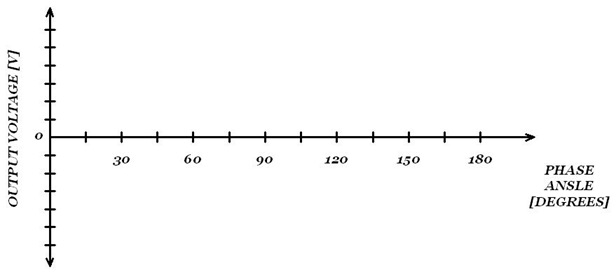
    Static transfer function for a single-phase bridge Figure 18: Static transfer function for a single-phase bridge.
    (21) Set the rocker switch on the Enclosure / Power Supply to the 0 position. Remove all leads and cables.
    CONCLUSION
    In this exercise, you observed that a single-phase thyristor bridge can operate both as a controlled rectifier and as inverter. You saw that a bridge made with two thyristors and two diodes has same characteristics as a four-thyristor bridge with a free-wheeling diode, but is more economical to build.
    REVIEW QUESTIONS
    1. In what direction is active power transferred by a bridge operating in the rectifier mode? . . . . . . . . . .
    2. Under what conditions can a thyristor bridge operate in the inverter mode? . . . . . . . .
    3. In what direction is active power tranferred by a bridge operating in the inverter mode? . . . . . . . . . . . .
    4. Which bridge configuration using two thyristors and two diodes requires the addition of a free-wheeling diode? Explain why.    . . . . . . . . . . . . . . .
    5. What is the role of the inductor in the bridge rectifier/inverter circuit?    . . . . . . . . . . . . . . . .
    CAUTION
    High voltages are present in the laboratory exercise! Do not make or modify any banana jack connection with the power on unless otherwise specified!
    previous Rectifier and inverter modes

    Rectifier and inverter modes

    The function of the rectifying circuits seen so far is to convert ac current to dc current. The process is shown in Figure 6. Since the ideal rectifies does not consume power, the active power supplied by the source must be absorbed by the load. Note that the term load is used in its most general sense. A load can even be a voltage source, as in the case of a battery charger circuit.
    An inverter is a circuit which performs the opposite function of a rectifier; it converts dc current to ac current. Figure 7 shows a general inverter system.
    The active power supplied by the source is consumed by the load, as the ideal inverter does not consume power.
    Inverters fall into two categories:
    1. the self-commutated or autonomous inverter in which the frequency of the output ac current is proportional to the triggering rate of the thyristors;
    2. the line-commutated or non-autonomous inverter in which the frequency of the output ac current is imposed by the ac network to which the inverter is connected.


    Rectifier: A general rectifier system Figure 6: A general rectifier system.
    Rectifier: A general inverter system Figure 7: A general inverter system.
    The frequency of self-commutated inverters is fixed. You will use the line-commutated inverter in this exercise.
    The single-phase thyristor bridge can be used both as a rectifier and as an inverter. The inductor is large enough to ensure continuous conduction over a wide range of firing angles. The power supplied to the battery is P0 = I × E0, where E0 is the average dc voltage at the output of the bridge.
    Rectifier: Single-phase bridge with active dc load Figure 8: Single-phase bridge with active dc load.
    The average dc voltage E0 decreases as the firing angle α is increased, as shown in Figure 9 and 10. However, current flows only as long as voltage E0 is more positive than the battery voltage EB. If α is large, say 75°, voltage E0 is very small and current will only flow if voltage EB is near zero.
    Rectifier: Waveform for single-phase bridge in rectifier mode (α = 0°) Figure 9: Waveform for single-phase bridge in rectifier mode (α = 0°).
    Rectifier: Waveforms for single-phase bridge in rectifier mode (α = 30° Figure 10: Waveforms for single-phase bridge in rectifier mode (α = 30°)
    If the firing angle α is greater than 90°, ED becomes negative. In this case, current will only flow if the polarity of the battery voltage is reversed, so that ED is still higher than EB. This is illustrated in Figure 11. The power supplied to the battery is still P0 = I × E0. However, since the voltage E0 is negative, this power is negative, showing that power is actually transferred from the the battery to the ac source. The bridge is now operating as a line-commutated inverter, converting dc power to ac. 
    Rectifier: Waveform for single-phase bridge in inverter mode (α = 150° Figure 11: Waveform for single-phase bridge in inverter mode (α = 150°)
    Procedure summary
    In the first part of the exercise, you will set up the equipment.
    In the second part, you will observe the operation f a controlled bridge supplying a passive load, with both a resistive and an inductive load.
    In the third part, you will set up two different bridge configurations having two thyristors and two diodes.
    In the fourth part, you will operate a thyristor bridge in both the rectifier and the inverter modes. The reversible dc power supply circuit (see Familiarization with the Reversible DC Power Supply) is used to simulate a battery.
    previous Bridge rectifier with two thyristors and two diodes
    next Thyristor Single-Phase Bridge Rectifier/Inverter (PROCEDURE)

    Bridge rectifier with two thyristors and two diodes


    A single-phase bridge can be made using two thyristors and two diodes. Figure 4 shows an example of such a circuit.
    This circuit offers the same control as four-thyristor bridge. In addition, the output voltage never becomes negative, even when the load is inductive. This is because the two diodes provide a free-wheeling path: they conduct while the energy stored in the inductor is released. This circuit operates as the circuit of Figure 3, yet has one less component and requires only two thyristors.
    Figure 5 shows another bridge with two thyristors and a free-wheeling diode. This circuit could operate without the free-wheeling diode. In this case, the free-wheeling path would change every half-cycle of the ac source voltage. Q1 and D1 would free-wheeling during part of one half-cycle, and Q2 and D2 during part of the second half-cycle.
    Rectifier: Bridge rectifier with two thyristors on common ac line Figure 4: Bridge rectifier with two thyristors on common ac line.
    The free-wheeling D3 is necessary, however, to ensure that the circuit be able to turn off an inductive load. Without this diode, when the gate pulses are stopped, the current may never drop to zero and one thyristor may continue to conduct. The free-wheeling diode also relieves the thyristors from free-wheeling duty, allowing the use of lower power thyristors.
    Rectifier: Bridge rectifier using two common-cathode thyristors Figure 5: Bridge rectifier using two common-cathode thyristors.
    One advantage of the circuit in Figure 5 is that the firing control circuit can be simplified since the cathodes of the two thyristors are at a common potential. Both the circuit of Figure 4 and that of Figure 5 are of lower cost than a four-thyristor bridge of comparable power, nad both allow control of power from 0 to 100%. Unlike the four-thyristor bridge, however, these bridge cannot be used in the inverter mode, which is explained in the next section.
    previous Thyristor Single-Phase Bridge Rectifier/Inverter
    next Rectifier and inverter modes

    Thyristor Single-Phase Bridge Rectifier/Inverter

    Objectives
    1. To demonstrate the operation of a thyristor single-phase bridge in both rectifier and inverter modes.
    2. To demonstrate the operation of bridge formed with thyristors and two diodes.
      Discussion
      Thyristor single-phase bridge (Figure 1) operates on the same principle as the diode single-phase bridge rectifier, except that each thyristor begins to conduct only when a current pulse is injected into the gate (providing that the thyristor is forward biased). Once a thyristor begins to conduct, it continues to conduct until the current flowing through it becomes zero. With a resistive load, the current becomes zero the instant the ac source voltage Es passes through zero volts. Therefore, the output is a full-wave rectified voltage which is always positive (Figure 2(b)).
      Rectifier: Thyristor single-phase bridge
      Figure 1: Thyristor single-phase bridge.
      Since conduction can be initiated at any angle in the waveform between 0° and almost 180°, the average output voltage E0, and therefore the average current, can be varied between 0 and 100%.
      Rectifier: Output waveforms for a thyristor bridge
      Figure 2: Output waveforms for a thyristor bridge.
      The following equation gives the value of the average output voltage E0 as a function of the firing angle. this equation is only when conduction is continuous, that is, when the on-time of the thyristors corresponds to 180°.
      E0 = 0.9 Es cos α
      where Es is the voltage of the source [V ac]
               α is the firing angle in degrees.
      When the load is inductive, the output voltage can be negative for part of the cycle, as shown in figure 2(c). This is because an inductor stores energy in its magnetic field which is later released. Current continuus to flow, and the same thyristors continue to conduct, until all the stored energy is released. Since this occurs some time after the ac source voltage passes through zero, the output voltage becomes negative for part of cycle.
      The negative part of the output voltage waveform reduces the average output voltage E0. As seen the previous exercise, a free-wheeling diode can be placed in the circuit to prevent the output voltage from going negative (Figure: 3). When the output voltage begins to go negative, the free-wheeling diode conducts. This maintains the output voltage at approximately zero while the energy stored in the inductor is released. The output voltage waveform is the same as for a purely resistive load (Figure: 2(b)), and the average output voltage is therefore greater than it would be without the free-wheeling diode. The addition of a free-wheeling diode makes the output current waveform smoother.
      Rectifier: Thyristor single-phase bridge with free-wheeling diode Figure 3: Thyristor single-phase bridge with free-wheeling diode.
      next Bridge rectifier with two thyristors and two diodes

      Sinusoidal PWM 3-Phase Inverter

      Dc-to-ac converters are known as inverters. The function of an inverter is to change the dc input voltage to an ac output voltage of desired magnitude and frequency. The output voltage waveforms of ideal inverters should be sinusoidal. However, the output of practical inverters contains harmonics. For high power applications, low distorted sinusoidal waveforms are required. Harmonic contents could be minimized by the use of high-speed. semiconductor switching techniques
      Inverters are widely used in industrial applications-
      motor drives, UPS, induction heating, standby power supplies, etc.
      input may be a battery, fuel cell, solar cell, or there dc source
      Dc-to-ac inverters can make smooth transition into the rectification mode, where the flow of power reverses from the ac side to the dc side. Two types of inverters: single-phase inverters and three-phase inverters.
      n = j{m_f} \pm k
      j = 1,3,5,...{\rm{  }}for{\rm{  }}k = 2,4,6,...
      j = 2,4,6,...{\rm{  }}for{\rm{  }}k = 1,5,7,...
      {\hat v_{ab1}} = M\sqrt 3 \frac{{{V_S}}}{2}{\rm{ }}for{\rm{ 0}} \le {\rm{m}} \le {\rm{1}}
       power-electronic-converter-DC-AC CONVERTERS
      previous Three-Phase Inverter

      Three-Phase Inverter


      1. Used to supply three-phase loads
      2. Three single-phase inverters could be used, however, 12 switches are necessary, as a result, less efficient
      3. Consists of three legs, one for each phase
      4. One of the two switches in a leg is always ON at any instant
      5. Output of each leg depends on Vs and the switching status


      power electronic converter: Three-Phase Inverter
      Three-Phase PWM Inverter


      power electronic converter: DC-AC CONVERTERS{v_{ab}}(t) = \sum\limits_{n = 1,3,5,..}^\infty  {\frac{{4{V_S}}}{{n\pi }}\sin (\frac{{n\pi }}{3})\sin n(\omega t + \frac{\pi }{6})}

      {v_{bc}}(t) = \sum\limits_{n = 1,3,5,..}^\infty  {\frac{{4{V_S}}}{{n\pi }}\sin (\frac{{n\pi }}{3})\sin n(\omega t - \frac{\pi }{2})}

      {v_{ca}}(t) = \sum\limits_{n = 1,3,5,..}^\infty  {\frac{{4{V_S}}}{{n\pi }}\sin (\frac{{n\pi }}{3})\sin n(\omega t - \frac{{7\pi }}{6})}

      \begin{array}{l}
{V_{Ln(rms)}} = \frac{{4{V_S}}}{{\sqrt 2 n\pi }}\sin (\frac{{n\pi }}{3})\\
{V_{L1(rms)}} = \frac{{4{V_S}}}{{\sqrt 2 \pi }}\sin (\frac{\pi }{3}) = 0.7797{V_S}
\end{array}


      power electronic converter: DC-AC CONVERTERS
      Delta and Y-Connected
      power electronic converter: DC-AC CONVERTERS
      Equivalent Circuits
      power electronic converter: DC-AC CONVERTERS power electronic converter: DC-AC CONVERTERS Equivalent Circuits for Y-Load

      {v_{ab}}(t) = \sum\limits_{n = 1,3,5,..}^\infty  {\frac{{4{V_S}}}{{\sqrt 3 n\pi }}\sin (\frac{{n\pi }}{3})\sin n(\omega t)}

      {v_{bc}}(t) = \sum\limits_{n = 1,3,5,..}^\infty  {\frac{{4{V_S}}}{{\sqrt 3 n\pi }}\sin (\frac{{n\pi }}{3})\sin n(\omega t - \frac{{2\pi }}{3})}

      {v_{ca}}(t) = \sum\limits_{n = 1,3,5,..}^\infty  {\frac{{4{V_S}}}{{\sqrt 3 n\pi }}\sin (\frac{{n\pi }}{3})\sin n(\omega t - \frac{{4\pi }}{3})}

      previous Sinusoidal PWM
      next Sinusoidal PWM 3-Phase Inverter