Setting up the equipment
(1) Install the Power Supply, the Enclosure / Power Supply, the DC Motor / Generator, the Four-Pole Squirrel-Cage Induction Motor, the Resistive Load, the Smoothing inductors, the DC Voltmeter/Ammeter, the AC Ammeter, the Three-Phase Wattmeter/Varmeter, the Temdem Rheostates, the Power Thyristors, and the Power Diodes modules in the Mobile Workstation.
Note: Align the brushes of the DC Motor / Generator in the neutral position by centering the metal tab on the red mark (on casing).
(2) Install the Thyristor Firing Unit and and the Current/Voltage Isolators in the Enclosure / Power Supply.
Note: Before installing the Thyristor Firing Unit, make sure that switches SW1 and SW2 (located on the printed circuit board) are in the 0 position.
(3) Make sure that the main power switch of the Power Supply is set to the 0 (OFF) position. Set the voltage control knob to 0. Connect the Power Supply to a three-phase wall receptacle.
(4) Plug the Enclosure / Power Supply line cord into a wall receptacle. Set the rocker switch of the Enclosure / Power Supply to the 1 (ON) position.
(5) On the Power Supply, set the 24-V ac power switch to the 1 (ON) position.
(6) Make sure that the toggle switches on the Power Thyristors and the Resistive Load modules are all set to the 0 (open) position.
Controlled bridge supplying a passive load
(7) Set up the circuit of Figure 12 using the resistive load Z (a). To simplify connecting the thyristors, set both interconnection switches on the Power Thyristors module to the 1 position.
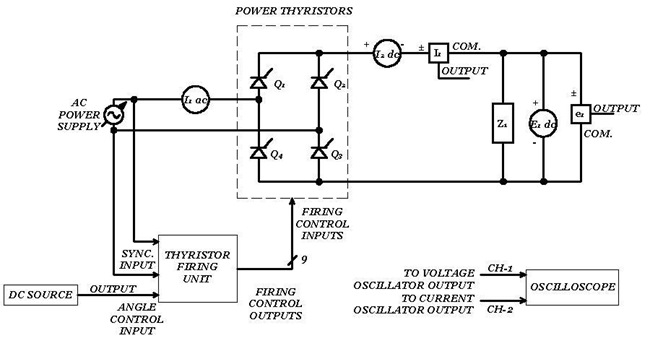
Figure 12: Thyristor bridge circuit.
LINE VOLTAGE (Vac)
|
I1ac
(A)
|
I2dc
(A)
|
I1
(A)
|
E1dc
(V)
|
e1
(V)
|
Z1(a)
|
Z1(a)
|
120
|
2.5
|
2.5
|
10
|
150
|
300
|
R=60Ω
|
R=60Ω, L=0.2H (3Adc max)
|
220
|
1.5
|
1.5
|
5
|
300
|
600
|
R=220Ω
|
R=220Ω, L=0.8H (1.5Adc max)
|
240
|
1.5
|
1.5
|
5
|
300
|
600
|
R=240Ω
|
R=240Ω, L=0.8H (1.5Adc max)
|
(8) Make the following setting:
On the Power Supply
Voltage Selector . . . . . . . . . . . . . . . . . . . . . . . 4-N
On the Thyristor Firing Unit
ANGLE CONTROL COMPLEMENT . . . . . . . . . . . . . . . 0
ANGLE CONTROL ARC COSINE . . . . . . . . . . . . . . . . 0
FIRING CONTROL MODE . . . . . . . . . . . . . . . . . . . . 1~
DC SOURCE . . . . . . . . . . . . . . . . . . . . . . . . . . . MIN.
On the Oscilloscope
Channel-1 Sensitivity . . . . . . . . 5 V/DIV. (DC coupled)
Channel-2 Sensitivity . . . . . . . . 2 V/DIV. (DC coupled)
Time Base . . . . . . . . . . . . . . . . . . . . . . . 5 ms/DIV.
Trigger . . . . . . . . . . . . . . . . . . . . . . . . . . . . . LINE

Figure 13: Voltage and current waveforms (α = 45°).
(9) On the power Supply, make sure that the voltage control knob is set to the 0 position then set the main power switch to 1 (ON). Set the voltage control knob so that voltage indicated by the Power Supply voltmeter is equal to 90 % of the nominal line-to-neutral voltage.
On the Thyristor Firing Unit, set the FIRING ANGLE to 45°. Sketch the voltage and current waveforms in Figure 13.
Fill in the first row of Table 1.
LOAD
Z1
| OUTPUT
VOLTAGE
E1 dc
| OUTPUT
CURRENT
I1 dc
| OUTPUT
POWER
P0 = E1 × I1
|
CONDUCTION
ANGLE
|
| V | A | W | degrees |
| (a) Resistive | | | | |
| (b) Inductive | | | | |
Table 1: Measurements for controlled bridge (α = 45°).
On the Power Supply, set the voltage control knob to 0 then set the main power switch to 0 (OFF).
(10) Change the load in the circuit to the inductive load Z1 (b).
On the Power Supply, set the main power switch to 1 (ON). Set the voltage control knob so that the voltage indicated by the Power Supply voltmeter is equal to 90 % of the nominal line-to-neutral voltage. Sketch the voltage and current waveforms in figure 13.
Fill in the second row of Table 1.
On the Power Supply, set the voltage control knob to 0 then set the main power switch to 0 (OFF).
(11) Add a free-wheeling diode to the circuit, as shown in Figure 14. On the Power Supply, set the main power switch to 1 (ON), and set the voltage control knob to 90(%)

Figure 14: Thyristor bridge with free-wheeling diode.
LOAD
Z1
|
OUTPUT
VOLTAGE
E1 dc
|
OUTPUT
CURRENT
I1 dc
|
OUTPUT
POWER
P0 = E1 × I1
|
| V | A | W |
| (b) Inductive | | | |
Table 2: Measurements for controlled bridge with free-wheeling diode.
Single-phase bridge with two thyristors and two diodes
(12) Set up the circuit of Figure 15.

Figure 15: Bridge rectifier wit two thyristors on common ac line.
LINE VOLTAGE (Vac)
|
I1ac
(A)
|
I2dc
(A)
|
I1
(A)
|
E1dc
(V)
|
e1
(V)
|
Z1(a)
|
120
|
2.5
|
2.5
|
10
|
150
|
300
|
R=60Ω, L=0.2H (3Adc max)
|
220
|
1.5
|
1.5
|
5
|
300
|
600
|
R=220Ω, L=0.8H (1.5Adc max)
|
240
|
1.5
|
1.5
|
5
|
300
|
600
|
R=240Ω, L=0.8H (1.5Adc max)
|
On the Power Supply; set the main power switch to 1 (ON), and set the voltage control knob so that the voltage indicated by the Power Supply voltmeter is equal to 90 % of the nominal line-to-neutral voltage. Vary the firing angle and observe the waveforms. Then set the firing angle to 45° and fill in the first row of Table 3.
CONFIGURATION
|
OUTPUT
VOLTAGE
E1 dc
|
OUTPUT
CURRENT
I1 dc
|
OUTPUT
POWER
P0 = E1 × I1
|
|
V
|
A
|
W
|
Two thyristors on common ac line
| | | |
Common-cathode thyristors
| | | |
Table 3: Measurements for bridge rectifiers with two thyristors and two diodes (α = 45°).
Compare the voltage waveform at the output of this bridge to those obtained with the thyristor bridges of Figure 12 and 14.
On the Power Supply, set the voltage control knob to 0 then set the main power switch to 0 (OFF).
(13) Set up the circuit of Figure 16.

Figure 16: Bridge rectifier with common-cathode thyristors and free-wheeling diode.
On the Power Supply, set the main power switch to 1 (ON), and set voltage control knob so that the voltage indicated by the Power Supply voltmeter is equal to 90 % of the nominal line-to-neutral voltage. Vary firing angle and observe the waveforms. Then set the firing angle to 45° and fill in the second row to Table 3.
Compare the voltage waveform at the output of this bridge to those obtained with the bridge of Figure 15.
(14) On the Power Thyristors, connect the FIRING CONTROL INPUTS DISABLE jack to + 5 V jack on the Enclosure / Power Supply. This disables the gate pulses to all of the thyristors, and shuts off current to the load. What happens? . . . . . .
(15) On the Power Thyristors, disconnect the FIRING CONTROL INPUTS DISABLE jack from the + 5 V jack on the ENCLOSURE / Power Supply.
On the Power Supply, set the voltage control knob to 0 then set the main power switch to 0 (OFF).
Remove the free-wheeling diode from the circuit. Then, on the Power Supply, set the main power switch to 1 (ON), and set the voltage control knob to 90(%).
Could this bridge operate without the free-whiling diode? Explain. . . . . . . . . . . . .
ON the Power Thyristors, connect the FIRING CONTROL INPUTS DISABLE jack to + 5 V jack on the Enclosure / Power Supply. This disables the gate pulses to all of the thyristors. Disconnect then reconnect the plug at the FIRING CONTROL INPUTS DISABLE jack several times. Explain what you observe. . . . . . . . . . . .
On the Power Supply, set the voltage control to 0 then set the main power switch to 0 (OFF).
(16) Set up the circuit of Figure 17.

Figure 17: Controlled bridge rectifier/Inverter circuit.
(17) On the Thyristor Firing Unit, set the DC SOURCE control to MAX.
On the Tandem Rheostats, set the control knob to the centre position. On the Power Supply, make sure that the voltage control knob is set to the 0 position, then set the main power switch to 1 (ON). The Four-Pole Squirrel-Cage Induction Motor should began to rotate.
On the Power Supply, set the voltage control knob so that the voltage indicated by the Power Supply voltmeter id equal to 90 % of the nominal line-to-neutral voltage.
Adjust the Tandem Rheostate to obtain the voltage E1 shown in Table 4 at the generator terminals of the motor-generator set.
LINE
VOLTAGE
|
ACTIVE LOAD
VOLTAGE
E1 dc
|
V ac
|
V
|
120
|
80
|
220
|
160
|
240
|
160
|
Table 4: Active load voltage E1.
Vary the firing angle and observe the effect on the waveforms and on the current delivered to the active load. How does the current vary as the firing angle is reduced to 0°? . . . . . . . . .
(18) On the Thyristor Firing Unit, adjust the FIRING ANGLE to 0°. Adjust the Tandem Rheostates to obtain the current I1 shown in Table 5.
LINE
VOLTAGE
|
CURRENT
I1 dc
|
V ac
|
A
|
120
|
1.0
|
220
|
0.5
|
240
|
0.5
|
Table 5: Current I1 delivered to load.
For each FIRING ANGLE in Table 6, adjust the Thyristor Firing Unit to the given firing angle, then adjust the Tandem Rheostates to obtain the current I1 shown in Table 5. Observe the waveforms on the oscilloscope. Calculate the theoretical output voltage, record the measured voltage (E1dc), and calculate the power delivered to the reversible dc power supply.
FIRING ANGLE
|
THEORETICAL
VOLTAGE
E0 = 0.9 Escos
|
MEASURED
VOLTAGE
E1 dc
|
POWER
P = E1 × I1
|
degrees
|
V
|
V
|
W
|
0
| | | |
15
| | | |
30
|
|
|
|
45
|
|
|
|
60
|
|
|
|
75
|
|
|
|
90
|
|
|
|
105
|
|
|
|
120
|
|
|
|
135
|
|
|
|
150
|
|
|
|
165
|
|
| |
Table 6: Data for bridge rectifier/inverter circuit.
(19) Turn the knob on the Tandem Rheostates to the centre position, so the field current of the DC Motor / Generator is zero. On the Power Supply, set the voltage control knob to 0 then set the main power switchand the 24-V ac power switch to 0 (OFF).
For what range of firing angle does the bridge operates as a rectifier?
For what range does it operate as a inverter? Explain. . . . . . . . . . . .
(20) In Figure 18, plot the voltage E1 versus the firing angle. Then, in the same figure, plot the theoretical relationship E0 = 0.9 Es cos , where Es is the line voltage. Compare the two curves.
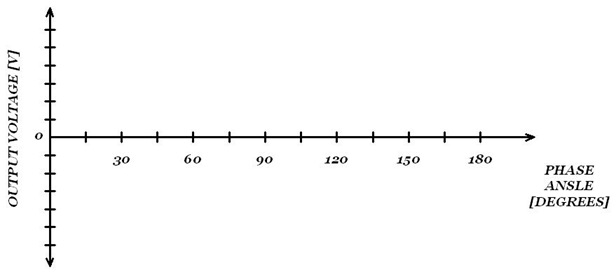
Figure 18: Static transfer function for a single-phase bridge.
(21) Set the rocker switch on the Enclosure / Power Supply to the 0 position. Remove all leads and cables.
CONCLUSION
In this exercise, you observed that a single-phase thyristor bridge can operate both as a controlled rectifier and as inverter. You saw that a bridge made with two thyristors and two diodes has same characteristics as a four-thyristor bridge with a free-wheeling diode, but is more economical to build.
REVIEW QUESTIONS
-
In what direction is active power transferred by a bridge operating in the rectifier mode? . . . . . . . . . .
-
Under what conditions can a thyristor bridge operate in the inverter mode? . . . . . . . .
-
In what direction is active power tranferred by a bridge operating in the inverter mode? . . . . . . . . . . . .
-
Which bridge configuration using two thyristors and two diodes requires the addition of a free-wheeling diode? Explain why. . . . . . . . . . . . . . . .
-
What is the role of the inductor in the bridge rectifier/inverter circuit? . . . . . . . . . . . . . . . .
CAUTION
High voltages are present in the laboratory exercise! Do not make or modify any banana jack connection with the power on unless otherwise specified!
previous
Rectifier and inverter modes
 Figure 1: Three-phase, six-pulse converter with resistive load.
 Figure 1: Three-phase, six-pulse converter with resistive load.
 Figure 2: Waveforms for the three-phase, six-pulse converter.
 Figure 3: Three-phase bridge using three common-cathode thyristors.


