Power Semiconductor Devices

More on this category »

Latest Post

THREE-PHASE DUAL CONVERTER


In many variable-speed drives, the four quadrant operation is generally required and three phase dual converters are extensively used in applications up to the 2000kW level.


THREE-PHASE DUAL CONVERTER 
 

THREEPHASE DUAL CONVERTER WAVE FORMS
previous Three-phase full-wave Controlled Rectifier

Three-phase full-wave Controlled Rectifier


Three-phase full-wave Controlled Rectifier with highly inductive load (Continuous load current)

Average Load/Output Voltage

{V_0} = \frac{{3\sqrt 3 {V_m}}}{\pi }\cos \alpha

{V_0} = \frac{{3\sqrt 6 V}}{\pi }\cos \alpha


Vm peak phase voltage

V rms phase voltage
Three-phase full-wave Controlled Rectifier with highly inductive load (Continuous load current)

Three-phase full-wave Controlled Rectifier with highly inductive load (Continuous load current)
Three-phase full-wave Controlled Rectifier with highly inductive load
Voltage and current waveforms of a three-phase full converter with a highly inductive load is shown in figure. This converter provides two quadrant operation and thyristors are fired at an interval of π/3 degrees. Since thyristors are fired every 60°, the frequency of the output ripple voltage is six times the frequency of the supply voltage. At ωt = π /6 + α, thyristor S6 is already conducting and thyristor S1 is turned on. For the interval ωt of π/6 to π/2 thyristors S1 and S6 conduct, and line to line voltage vab appears across the load. At ωt = π /2 + α, thyristor S2 is turned on and thyristor S6 is turned off due to natural commutation. This occurs because when thyristor S2 is turned on, the line to line voltage across thyristor S6 is the positive voltage vbc from cathode to anode which reverse biases thyristor S6. During the interval ωt of (π /2 + α) (5 π /6 + α), thyristors S1 and S2 conduct and line to line voltage appears across the load. The firing sequence of the thyristors is: 12, 23, 34, 45, 56 and 61.
The average output voltage is given by
{V_{dc}} = \frac{6}{{2\pi }}\int\limits_{\pi /6 + \alpha }^{\pi /2 + \alpha } {{V_{ab}}d\left( {\omega t} \right)}
{V_{dc}} = \frac{3}{\pi }\int\limits_{\pi /6 + \alpha }^{\pi /2 + \alpha } {\sqrt 3 {V_m}\sin \left( {\omega t + \frac{\pi }{6}} \right)d\left( {\omega t} \right)}
{V_{dc}} = \frac{{3\sqrt 3 {V_m}}}{\pi }\cos \alpha
The maximum output dc voltage is given by
{V_{dm}} = \frac{{3\sqrt 3 {V_m}}}{\pi }
The rms output voltage is given by
{V_{rms}} = {\left[ {\frac{3}{\pi }\int\limits_{\pi /6 + \alpha }^{\pi /2 + \alpha } {{{\left( {\sqrt 3 {V_m}\sin (\omega t + \frac{\pi }{6})} \right)}^2}d(\omega t)} } \right]^{\frac{1}{2}}}
{V_{rms}} = \sqrt 3 {V_m}{\left( {\frac{1}{2} + \frac{{3\sqrt 3 }}{{4\pi }}\cos 2\alpha } \right)^{\frac{1}{2}}}
Three-phase Converter Output Characteristics for continuous load current (Full Converter)
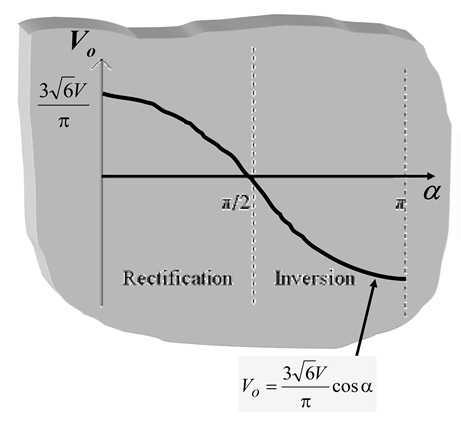
For fully controlled rectifier, The DC Motor operates in two modes.
Rectification [As Motoring]
V0 = positive
Ea = Positive
Io= positive
Power Flow (+ve) from input AC to DC machine
Inversion [As Regenerative Braking]
V0 = negative
Ea = negative
Io= positive
Power Flow (-ve) from DC machine to AC supply
Thyristor based Rectifiers (3-phase)Thyristor based Rectifiers (3-phase) Thyristor based Rectifiers (3-phase)
Ed becomes smaller as α increases, but still each thyristor conducts 120 deg. Power flow is from AC side to DC side. Id=(Ed-E0)/R
Thyristor based Line Commutated Inverter (3-phase)
Id=(Eo-Ed)/R, real power flow is from DC to AC side, Polarity of Ed is reversed.
Triggering range:
Rectifier 15°-90°, inverter: 90°-165°. Thyristor may misfire for α less than 15° (def. 8°) for sudden change in line voltage and hence discontinuity in output current. If we go beyond 165°, the inverter may lose its ability to switch from one thyristor to the next. As a result currents build up very quickly until the CB trips. For safety margin max α is 150°.
previous Three-phase half-wave Controlled Rectifier
next THREE-PHASE DUAL CONVERTER

Three-phase half-wave Controlled Rectifier


Three-phase half-wave Controlled Rectifier circuit with R load


Three-phase half-wave Controlled Rectifier circuit with R load Three-phase half-wave Controlled Rectifier circuit with R load Average Load/Output Voltage
{V_{dc}} = \frac{3}{\pi }\int_{\pi /6 + \alpha }^\pi  {\sqrt 2 V\sin \theta d\theta }
       = \frac{{3\sqrt 2 }}{\pi }V\left( {1 + \cos \left( {\frac{\pi }{6} + \alpha } \right)} \right)
Three-phase half-wave Controlled Rectifier circuit
The rms output voltage is obtained from with resistive load

{V_{rms}} = {\left[ {\frac{3}{{2\pi }}\int\limits_{\frac{\pi }{6} + \alpha }^\pi  {V_m^2{{\sin }^2}\omega td\left( {\omega t} \right)} } \right]^{\frac{1}{2}}}
{V_{rms}} = \sqrt 3 {V_m}{\left[ {\frac{5}{{24}} - \frac{\alpha }{{4\pi }} + \frac{1}{{8\pi }}\sin \left( {\frac{\pi }{3} + 2\alpha } \right)} \right]^{\frac{1}{2}}}
For a continuous load current with highly inductive load, the average output voltage is given by
{V_{dc}} = \frac{3}{{2\pi }}\int\limits_{\pi /6 + \alpha }^{5\pi /6 + \alpha } {{V_m}} \sin \omega td\left( {\omega t} \right)
{V_{dc}} = \frac{{3\sqrt 3 {V_m}}}{{2\pi }}\cos \alpha
The rms output voltage is obtained from
{V_{rms}} = {\left[ {\frac{3}{{2\pi }}\int\limits_{\pi /6 + \alpha }^{5\pi /6 + \alpha } {V_m^2{{\sin }^2}\omega t\left( {\omega t} \right)} } \right]^{\frac{1}{2}}}
{V_{rms}} = \sqrt 3 {V_m}{\left[ {\frac{1}{6} + \frac{{\sqrt 3 }}{{8\pi }}\cos 2\alpha } \right]^{\frac{1}{2}}}
previous THREE-PHASE CONTROLLED RECTIFIER
next Three-phase full-wave Controlled Rectifier

THREE-PHASE CONTROLLED RECTIFIER


The majority of line-commutated rectifier/inverter used in industry operates on three-phase networks. Although their operation is more complex than single-phase rectifiers/inverters, they posses following advantages.
  1. Greater power transfer capability
  2. The output ripple current is reduced
The delay/firing angle is measured from the point where two line voltages are simultaneously at the same level.


THREE-PHASE WAVE FORMS

 
THREE-PHASE WAVE FORMS


EQUATIONS FOR THREE-PHASE VOLATGE

The three line-to-neutral voltages are given by (Vm is the peak phase voltage):
{V_{an}} = {V_m}\sin \omega t
{V_{bn}} = {V_m}\sin \left( {\omega t - \frac{{2\pi }}{3}} \right)
{V_{cn}} = {V_m}\sin \left( {\omega t + \frac{{2\pi }}{3}} \right)
The line to line voltages are given by:

{V_{ab}} = {V_{an}} - {V_{bn}} = \sqrt 3 {V_m}\sin \left( {\omega t + \frac{\pi }{6}} \right)
{V_{ba}} = {V_{bn}} - {V_{an}} = \sqrt 3 {V_m}\sin \left( {\omega t - \frac{{5\pi }}{6}} \right)
{V_{bc}} = {V_{bn}} - {V_{cn}} = \sqrt 3 {V_m}\sin \left( {\omega t - \frac{\pi }{2}} \right)
{V_{cb}} = {V_{cn}} - {V_{bn}} = \sqrt 3 {V_m}\sin \left( {\omega t + \frac{\pi }{2}} \right)
{V_{ca}} = {V_{cn}} - {V_{an}} = \sqrt 3 {V_m}\sin \left( {\omega t + \frac{\pi }{2}} \right)
{V_{ac}} = {V_{an}} - {V_{cn}} = \sqrt 3 {V_m}\sin \left( {\omega t - \frac{\pi }{6}} \right)
previous SINGLE-PHASE CONVERTERs
next Three-phase half-wave Controlled Rectifier