Power Semiconductor Devices

More on this category »

Latest Post

PREFABRICATED METER ASSEMBLIES

previous DIFFERENTIAL PRESSURE METERS
1. Insertion Fittings: Some manufacturers produce a dual-chambered, hand-operated, gear-driven apparatus which allows one person to change an orifice plate. An insertable plate can be changed without system shutdown or removal of flanges. The mechanism is constructed so that there is no fluid spillage or loss and no danger to the operator. For specific product information consult manufacturers of fluid flow metering equipment.
2. Recommended Applications: Prefabricated meter assemblies are Particularly suited for low flow in pipes of less than 2 inches in diameter” A common application is for measuring natural gas flow to specific pieces of equipment.
Orifice Meter With Corner Taps
FIGURE 5-5. Orifice Meter With Corner Taps
3. Limitations: Prefabricated orifice meter assemblies cannot measure over an infinite range. The turndown of an orifice meter is 3:1 and, therefore, predetermined orifice sizing is required to obtain accurate measurement data.
4. Installation: Prefabricated meter assemblies are permanently installed meters fitted in a specially designed length of pipe with permanently located pressure taps. The complete assembly is installed in the pipe where flow is to be measured. The prefabricated assembly is sized for a particular flow range and is calibrated accordingly.
MAINTENANCE: The following procedures are the minimum required for the most common types of units. When developing maintenance schedules, refer to the manufacturer’s instructions. Annually disassemble meter and inspect and perform maintenance as follows:
(a) Check orifice for wear, i.e., roundness, size, and squareness of edge.
(b) Plate should be examined for warping with a straightedge.
(c) Plate should be examined for watermarks indicating condensate damming.
(d) Check pressure taps for burrs and/or debris.
e) Test dp transmitter with dead weight pressure tester and rescale if necessary.
(f) Dress off roughness on plate.
(g) Resize orifice, if necessary, based on flow of previous year. When orifice is resized, stamp the new diameter and coefficient on the holder.
(h) Flush all trapped sediment from unit.
(i) Reinstall orifice plate so that flow exits the bevelled side.
(j) Sensor lines should be blown down at regular intervals.
Since inspection of an orifice plate requires shutdown, scheduling may be predicated by system supply requirements.
ACCURACY AND RELIABILITY: Orifice meter accuracy is up to ±%0.75 percent of full scale. The major influence on accuracy is installation, where care must be taken to ensure proper installation of the run, pressure taps, and the tap tubing. Meter runs are highly reliable when used over the range of calibration. If removed for cleaning or inspection, they should be recalibrated before returning to service.
PRESSURE TAPS AND INDICATION DEVICES: A variety of pressure tap configurations are available for orifice plates. Various devices are used to quantitatively express the differential pressure. Each of the common tap options and dp devices are described in the following paragraphs.
1. Pressure Taps: The common tap options are: flange taps, corner taps, and radius taps.
1.1 Flange Taps: The most commonly recommended configuration is the flange tap (Figure 5-4). Pretapped flanges are standardized, convenient, and easily replaced.
1.2 Corner Taps: Carrier rings are drilled for pressure taps and insertion between existing flanges (Figure 5-5). This type of flange should only be used if the flange taps are unavailable. Standardization of equipment should be the goal of a well-planned system.
1.3 Radius and Vena Contracta Pipe Taps: These taps are mounted directly in the pipe (Figure 5-6). Although widely used in the past, they have been largely replaced with standardized flange taps.
2. Differential Pressure Devices: Dp devices are used to provide a quantitative display of the differential pressure; they are also called delta P and D P devices. The four most common dp devices are: manometer, diaphragm, bellows, and electronic. All new or replacement differential pressure installations should be electronic.
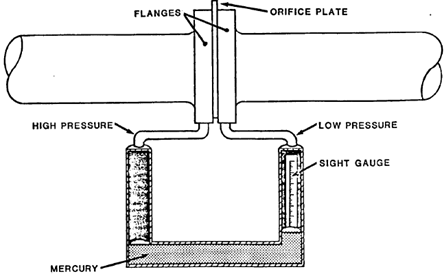
2.1 Manometer: The manometer is a rather simple device. One end of the manometer is attached to the high-pressure tap and the other end to the low-pressure tap of the orifice plate installation. As the dp created by the orifice plate is sensed by the manometer, a column of fluid in the manometer allows the dp to be read directly on a scale (Figure 5-7). Refer to the manufacturer’s instructions before installing a manometer.
2.2 Diaphragm: The diaphragm device includes a hermetically sealed diaphragm that is in an enclosure with one side open to the high-pressure tap and the other side to the low-pressure tap (Figure 5-8). The diaphragm moves as the dp created by the orifice meter is transmitted to the diaphragm chamber. A pointer attached to the diaphragm pivots about a fulcrum in the wall of the chamber and mechanically indicates the dp directly on a scale. Refer to the manufacturer’s instructions before installing a diaphragm.
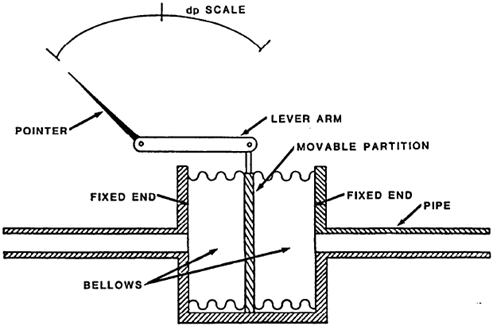
2.3 Bellows: A bellows device is similar to the diaphragm device in that the indicator pointer is attached to a component that is subject to movement caused by the dp. In a bellows device, a partition is hermetically sealed between two bellows in a confined compartment with an opening on one side to the high-pressure tap and another to the low-pressure tap (Figure 5-9). The input ends of the bellows are fixed to the compartment walls. As the dp forces the partition to move, compressing and expanding the respective bellows, a lever system causes a pointer to directly indicate the dp on a scale. Refer to the manufacturer’s instructions before installing a bellows.
2.4 Electronic: Electronic devices are also known as capacitance devices. In an electronic device, the dp is transmitted through an isolating diaphragm to a hermetically sealed sensing diaphragm in the center of the device (Figure 5-10). The sensing diaphragm is surrounded by silicone oil contained between capacitors. As the sensing diaphragm deflects in proportion to the dp, the position of the diaphragm is detected by capacitor plates on each side of the diaphragm. The differential capacitance between the plates and the diaphragm is converted electronically to a 2-wire, 4-20 mA, or 0-10 volt data transmission signal. Electronic devices are available in both square root and linear function models. Solid state, plug-in components simplify maintenance/repairs.
2.5 Calibration: Static calibration should be performed on all dp devices at least every 6 months.
3 Data Transmission: Readings from various dp devices must often be transmitted to remote data collection and recording sites. his is because the dp device may be too remote to warrant onsite reading. Data transmission may also be necessary because there may be many widely dispersed devices to be read and it would be uneconomical to have each one read onsite; or a central data management point has been set up to collect, record, plot, reduce, and analyze all flow data. All the taps for dp will accommodate remote transmission fittings along with the various dp devices.
Orifice Meter With Radius and Vena Contracta Pipe Taps
FIGURE 5-6. Orifice Meter With Radius and Vena Contracta Pipe Taps
Manometer
FIGURE 5-7. Manometer
Diaphragm
FIGURE 5-8. Diaphragm
3.1 Pneumatic: All dp devices, except electronic, can have readings transmitted to a remote site by pneumatic lines.
3.2 Electrical: Rather than pneumatically, the recommended means of data transmission is to have the dp electronically converted to an analog signal and transmitted electrically to a data collection center.
Bellows
FIGURE 5-9. Bellows
Electronic Device
Figure 5-10. Electronic Device
next VENTURI TUBES

DIFFERENTIAL PRESSURE METERS

previous DIAPHRAGM GAS METERS
ORIFICE PLATE METERS
Orifice plate meters are the most common meter used in industry today. It is estimated that over 50 percent of the devices used for measuring fluids are orifice plate type. The widespread use of orifice plates provides a great deal of background and operational experience in a variety of situations.
1. Operating Principles: Orifice plates can be used to measure flow because of the velocity-pressure relationship that exists in a flowing fluid. When a restriction, such as an orifice plate, is inserted into a stream, the fluid velocity must increase when passing through the restriction. The increase in velocity is accompanied by a proportional drop in pressure on the downstream side of the orifice plate (Figure 5-l). Since the pressure drop across the meter is proportional to the square of the flow rate, it is possible to calculate the flow rate by measuring the differential pressure (alp) before and after the orifice. Instruments of this type are known as inferential meters as they do not physically measure the flow, but rather “infer’s it from the known relationship between pressure and velocity.
METER DESIGNS: There are different orifice plate designs such as square-edged, one-quarter circle, and conical. For the majority of flow measurements involving gases, air, steam, and water, the square-edged orifice plate is used. Other configurations are primarily designed to address particular situations such as high viscosity, erosive fluids, and fluids containing suspended material.
Typical Orifice Plate Conditions
FIGURE 5-1. Typical Orifice Plate Conditions
1. Square-Edged Orifice: The orifice is sized to meet one specific anticipated flow rate. The upstream face of the orifice is flat with a square edge where the orifice meets the plate surface (Figure 5-2). If the side with a beveled or recessed edge is facing upstream, erroneous data will result.
1.1 Recommended Applications: Square-edged orifice metering is applicable on gas, liquid, and steam flow systems when pipe sizes are greater than 2 inches in diameter.
SPECIAL ORIFICES: These orifices are designed for special flow situations. One-quarter circle and conical entrance devices address low-flow and high-viscosity situations. Their use is limited. In an effort to prevent a buildup of debris on the upstream side of an orifice plate, eccentric orifice plates are used where moisture-laden gases are flowing and segmental orifice plates are used where a liquid containing a large percentage of gas is flowing (Figure 5-2).
LIMITATIONS: Orifice meters cause some permanent pressure loss due to friction. Pressure loss, increased friction, and increased pumping costs may make orifice metering undesirable. The range of this metering system is limited from 3:1 to 4:1. Turndown ratio can be increased by using two or more dp transmitters of different rangeabilities with an obvious increase in cost. They may be mounted in series and connected to a decision processor that will select the appropriate transmitter dependent upon the differential pressure (alp) . Since transmitters are expensive, the use of multiple transmitters is a tradeoff between precision requirements and cost effectiveness. Other limitations are as follows:
  • Temperature range is to l,OOO°F.
  • Pressure limit is 6,000 psig.
INSTALLATION: The location of the orifice plate in the system is important. Whenever possible, it is preferable to locate the primary element in a horizontal line. For accurate flow measurement, the fluid must enter the primary element with a fully developed velocity profile, free from swirls or vortices. In addition, fluid must exit the bevelled side of the orifice. Such a condition is best achieved by the use of adequate lengths of straight pipe, both preceding and following the primary element. The minimum recommended lengths of piping are shown in Figure 5-3. The diagram in Figure 5-3 that corresponds closest to the actual piping arrangement for the meter location should be used to determine the required lengths of straight pipe on the inlet and outlet. These lengths are those necessary to limit errors due to piping configurations to less than ±%0.5 percent. If these minimum distances are not observed, or if the orifice plate is installed with the bevel on the inlet side, flow equations and resultant flow calculations may produce inaccurate data.
1. Meter Installation: Common methods of installing orifice plate meters are described in the following paragraphs.
Orifice Plates
FIGURE 5-2. Orifice Plates
Recommended Minimum Pipe Lengths Before and after Differential Pressure Meters
FIGURE 5-3. Recommended Minimum Pipe Lengths Before and After Differential Pressure Meters (From ASME Fluid Meters; used with permission) (Page 1 of 4)
Recommended Minimum Pipe Lengths Before and after Differential Pressure Meters
Figure 5-3. Recommended Minimum Pipe Lengths Before and after Differential Pressure Meters (From ASME Fluid Meters; used with permission) (Page 2 of 4)
Recommended Minimum Pipe Lengths Before and after Differential Pressure Meters
Figure 5-3. Recommended Minimum Pipe Lengths Before and after Differential Pressure Meters (From ASME Fluid Meters; used with permission) (Page 3 of 4)
Recommended Minimum Pipe Lengths Before and after Differential Pressure Meters
Figure 5-3. Recommended Minimum Pipe Lengths Before and after Differential Pressure Meters (From ASME Fluid Meters; used with permission) (Page 4 of 4)
Orifice Meter With Flange Taps
FIGURE 5-4. Orifice Meter With Flange Taps
1.1 Orifice Flanges: Special orifice flanges are the most commonly recommended method for meter installation. The pressure taps are drilled into the flanges themselves, which are welded onto the pipe. The orifice is inserted and secured between the two flanges (Figure 5-4).
1.2 Carrier Rings: Carrier rings are the second q ost common method of orifice plate installation. Pressure taps, typically corner taps, are drilled into the rings and the orifice plate is inserted between the rings. The rings and orifice are then inserted between existing pipe flanges (Figure 5-5).
1.3 Existing Flanges and Special Taps: The orifice plate can be inserted between existing pipe flanges and pressure taps drilled into the pipe. This method was widely used in the past, but has since been replaced with the more standardized orifice flanges.
next PREFABRICATED METER ASSEMBLIES

DIAPHRAGM GAS METERS

previous COMPOUND WATER METERS
Diaphragm meters are used only for gas metering. The principle elements of a diaphragm meter are flexible partitions or diaphragms of the measuring compartments, valves for controlling and directing the gas flow in filling and emptying the measuring compartments, appropriate linkage to keep the diaphragms and valves synchronized, register for counting the number of cycles, and maincase to house the components. To obtain continuous flow and power to operate the register, it is necessary to have three or more measuring compartments or chambers, with two or more movable walls. These walls are sealed with a flexible material that is impervious to gas. Movement of the walls or diaphragms are so regulated that the total displacement on successive cycles is the same. The amount of travel or stroke of the diaphragms is regulated in most meters by the radial position of the crankpin that the diaphragm linkage arms are attached to. Figure 4-7 shows the sequence for filling and emptying a meter that has two diaphragms and four measuring chambers. The most common unit of measurement for these meters is cubic feet. Diaphragm meters are available to fit pipe sizes up to 4 inches, with a maximum capacity of 12,000 cubic feet per hour.
INSTALLATION:
Diaphragm meters must be installed in the flow line, upstream of any activity or outlet they are monitoring. Always check manufacturer’s instructions prior to installation for the proper methods of handling, storage, transit, and installation. When installing a meter, be sure the following checks have been made and the indicated items are available.
(a) Securely restrain and properly cushion meters during transit to prevent tipping and excess jarring.
(b) Keep meter hubs covered and protected until ready for installation.
(c) When a separate pressure regulator is required, keep inlet and outlet plugged and protected until ready for installation.
(d) Ensure that the inlet piping is clean and does not contain any pipe scale, chips, rust flakes, or other foreign materials.
(e) Ensure that the meter is installed plumb and level.
(f) Check for meter shutoff valve on inlet side of meter.
(g) Check for adequate supply of meter connection gaskets.
(h) Ensure that location of meter provides proper protection from traffic or other hazards that may be present.
Operating Cycle, Four-Chamber Diaphragm Meter
FIGURE 4-7. Operating Cycle, Four-Chamber Diaphragm Meter
If remote reading or electronic transmitting devices are used, install in accordance with chapter 10 and the manufacturer’s instructions.
MAINTENANCE: The following inspection schedules are adequate for average installations.
1. Monthly Inspection: In addition to any instructions provided by the manufacturer, inspect meters monthly for the following conditions:
(a) Noisy operation of meter.
(b) Smooth movement of register.
(c) Leaks (repair if necessary).
(d) Cleanliness of glass cover on register dial (clean as needed).
2. Annual Inspection: In addition to the inspections in paragraph 3.1, inspect meters annually for the following conditions:
(a) Proper alignment and position in accordance with installation instructions.
(b) Cleanliness of meter box, housing, or pit, if one exists (clean as needed)
A schedule for cleaning and repairing meters is necessary, and should be based on the manufacturer’s recommendations.
next DIFFERENTIAL PRESSURE METERS

COMPOUND WATER METERS

previous POSITIVE DISPLACEMENT AND COMPOUND METERS
Compound meters are essentially two meters within a single housing. They are normally used in situations that require accurate measurement of cold water over a wide range of low to high flow rates. Compound meters are often used for measuring water used at apartment or office buildings, hotels, schools, hospitals, and industrial facilities.
1. Meter Designs: There are two types of compound meter design, parallel and series. The parallel type has two registers and, if either unit fails, the trouble can be detected by stoppage of its register. The series type has only one register. The unit of measurement must be specified as either gallons, liters, cubic feet, or cubic meters. Compound meters are available in nominal sizes of 2 to 10 inches, with a maximum capacity of 2,300 gallons per minute.
OPERATING PRINCIPLES: The main components of a compound meter are maincase, main line measuring chamber (turbine type), bypass measuring chamber (positive displacement type), compounding valve, and one or two registers. Compound meters operate in two modes; at low flows, only the bypass meter operate, as flow increases, the compounding valve opens, allowing the meter to operate at a higher range. In a parallel meter (Figure 4-5), the main line meter does not operate until the compounding valve opens. The bypass meter may or may not continue operating when the main line meter starts up. In the series meter, when the compounding valve is closed, water flows through the bypass meter. When the pressure differential in the bypass meter is great enough to cause the compounding valve to open, the main line meter is already running. The register is driven by a pair of ratchet drives, so that the unit that is producing q ore registration will drive the register. The main line unit is not called upon to start from rest at the changeover point, and thus loss of accuracy is avoided when the valve opens. Changeover usually begins at approximately 5 or 6 percent of maximum rating of the meter. Operating characteristics for compound meters are listed in Table 4-3.
LIMITATIONS: Rated maximum capacity for compound meters is shown in Table 4-3. Normal flow for these meters should not exceed approximately one-half of maximum capacity. Operating at maximum capacity should be limited to short periods or peak loads occurring after long intervals. Maximum pressure loss is 13.3 percent of maximum pressure for all sizes. Mechanical drive and some magnetic drive meters have changeable gears in the geartrain. Changing these gears allows the ratio between the motion of the positive displacement or turbine measuring chamber and the register to be calibrated for maximum accuracy of registration. The turndown ratio for these meters when used for cold water service covers a range of approximately 70:1 to 100:1 depending upon manufacturer, model, and size. Other limitations are as follows:
  • Temperature limit is 80°F.
  • Pressure limit is 150 psig.
  • Installation is permanent.
Failure to observe the manufacturer’s recommendations for minimum lengths of straight pipe to be installed, both before and after the meter, may result in inaccurate measurement and premature component wear.
Double-Register Compound Meter
FIGURE 4-5. Double-Register Compound Meter
TABLE 4-3. Compound Meter Operating Characteristics
image
INSTALLATION: Compound meters must be installed in the flow line, upstream of the activity or outlet they are monitoring. These meters do require a minimum length of straight pipe be installed before and after the meter. Figure 4-6 shows a typical compound meter installation. When installing a meter, be sure the following checks have been made and the indicated items are available.
(a) Check for meter shutoff valve upstream and downstream of meter.
(b) Check for strainer immediately upstream of meter.
(c) Check for adequate supply of meter connection gaskets.
(d) Ensure that location of meter provides protection from frost, traffic, or other hazards that may be present.
(e) Ensure that check valves or pressure-reducing devices are not installed upstream of the meter.
(f) Ensure that check valves and pressure-reducing devices located downstream of the meter are not located closer than 5 pipe diameters.
(g) Ensure that only full-open ball, gate, or plug valves are used immediately upstream of the meter. Butterfly valves are acceptable if they are a minimum of 5 pipe diameters upstream from the meter. Gate or butterfly valves can be used downstream.
(h) Ensure that installation is in accordance with direction-of-flow markings on the meter maincase.
(i) For optimum performance, ensure that meter is positioned in a horizontal plane.
If remote reading or electronic transmitting devices are used, install in accordance with chapter 10 and the manufacturer’s instructions. A bypass pipe with gate valves is recommended so that service will not be interrupted during maintenance.
Typical Compound Meter Installation
FIGURE 4-6. Typical Compound Meter Installation
MAINTENANCE: The following inspection schedules are adequate for most installations.
1. Monthly Inspection: In addition to any instructions provided by the manufacturer, inspect meters monthly for the following conditions:
(a) Meter is operating.
(b) Noisy operation (repair or replace meter as required).
(c) Leaks (repair as needed).
(d) Cleanliness of glass cover on register dial (clean as needed).
2. Annual Inspection: In addition to the inspections in paragraph above, inspect meters annually for the following conditions:
(a) Cleanliness of meter box, housing, or pit (clean as needed).
(b) Adequate protection from freezing (provide protection at least 1 month prior to start of the season).
3. Periodic Inspection: Periodic inspection of meters Is required to determine whether they are measuring accurately. The time interval between inspections should be based on local conditions and the amount of use. The manufacturer’s representative in any particular area should be familiar with local conditions and capable of assisting in the preparation of a schedule for periodic inspection of meters.
ACCURACY: Accuracy limits for water meters have been established by industry. For the meters discussed in this section, limits are based on tests run at four different rates of flow; maximum, intermediate, changeover, and minimum. The accuracy limits for the maximum and intermediate rates are from 97 to 103 percent of the quantity measured. The limits for the changeover rate are from 90 to 103 percent. For the minimum test flow rates shown in Table 4-3, compound meters shall register not less than 95 percent of the actual quantity measured.
next DIAPHRAGM GAS METERS